
The cuisine of Alcalá del Júcar, like that of the entire province of Albacete, is based primarilyon thequality of its raw ingredients and respect for tradition.
Typical local products includerosemary honey, Casas del Cerro brandy, virgin olive oil, saffron, and wine.
Gazpachos are the best-known dishes from La Mancha, prepared with game meat, not to mentionatascaburras, moje, migas ruleras and sweet migas, gachas and patatas a lo pobre, olla de aldea, potato broth with snails, rice with mountain serranas and fried crabs.
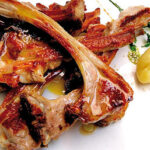
Lamb and goat, prepared in many different ways,game meats(hare, rabbit, and partridge),pork loin, and all kinds of sausages are particularly noteworthy.
In Alcalá del Júcar, many of the typical dishes are closely linked to the calendar of festivals and celebrations, combining the best of La Mancha and Mediterranean traditions. During Holy Week,stuffed meatballs andgarlic stewtake center stage.
Among its typical sweets, thehornazosat Easter, thenuégados at Christmas, thetorticas de chicharronesandmantecados during the slaughter, and thepumpkin rollsandquince jellyandsyrup in autumn stand out.
Gazpachos from La Mancha
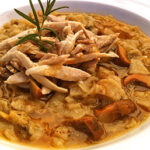
Gazpacho manchego, a classic dish from the rural tradition of La Mancha. A winter stew. It consists of a broth-based stew made with game meat (rabbit, hare, or partridge) and bread cake.
Rye bread is made without yeast. It is flat and round, similar to Arabic pita bread.
A similar dish can be found in Tuscany (Italy), where they make two simple dishes based on bread, "panzanella" and "acqua cotta," one hot and one cold, as is the case here with the two types of gazpacho, Andalusian and Manchego.
JAM JARS
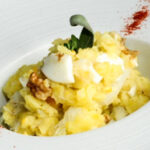
Atascaburras is a traditional dish eaten during the snowy season, very typical of Albacete and Alcalá del Júcar. It is made with cod and local produce such as potatoes, oil, hard-boiled eggs, and walnuts. Like most dishes from La Mancha, it combines the cuisine of La Mancha with that of the Mediterranean and is based primarily on the quality of its raw ingredients and respect for its traditions.
Legend has it that the dish originated during a heavy snowfall, when some shepherds had nothing to eat but potatoes and a few scraps of cod. It is said that they cooked the potatoes with the cod and mashed the mixture, but when they saw that it wasn't enough, they began to add olive oil and stir it with a mortar. The mixture thickened, becoming a delicacy for those shepherds, who named the dish (very similar to a cod mousse) "atascaburras."
NUEGADOS
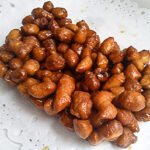
No home in Alcalá del Júcar would be complete without nuédagos at Christmas. This is a sweet of Arab origin made from walnuts, honey, and sugar, which is served with wafers.
This sweet is a precursor to today's nougat, and once again sums up the characteristics of shepherds' cuisine: simple to make, high in calories, and easy to store and transport. Perhaps this is why nuédagos have survived centuries of history and remain one of the most typical dishes of Castile.
To follow the most traditional recipe for nuégados, first crush the walnuts and make a syrup with sugar, honey, water, and cinnamon sticks. Add the walnuts to this syrup and, stirring constantly, leave it on low heat until a homogeneous mixture forms. Before the mixture cools, put a little on each wafer and it's ready!